 AI
AITomorrow's greatest founders. Featured today.
Certus AI · Turning missed restaurant calls into scalable infrastructure

Adam grew up in South Africa and did not follow the archetype “Stanford CS to YC” path.

In 2020, during COVID lockdowns, he got completely hooked on Call of Duty: Warzone. He became good enough to start entering cash tournaments—but his family (rightly) wasn’t eager to bankroll a full-time gaming habit.
When the money to enter tournaments ran out, he had two options: stop playing, or find a way to make money online.
He chose the second.
He spun up a Discord server, hosting military simulation events for games like Insurgency: Sandstorm on PlayStation. That small experiment—organizing strangers on the internet around something they care about—was the quiet start of his entrepreneurial life.
Around the same time, he explored making money online: Whop, internet operators, YouTube creators, etc. For the first time, he saw a very concrete alternative to the traditional script of “school → degree → job.”
Up to then, his plan was to become a lawyer and make good money. But the more he saw, the more it became obvious: you could build your own thing on the internet, with no degree and no permission.
At 16, Adam met his first co‑founder, Gurveer Singh, at the gym. They bonded over three things:
Neither wanted to go to university
Neither wanted a job
School didn’t like either of them—“rightly so,” in Adam’s words
They decided they needed to build a business.

The first vehicle: a marketing agency.
They started with what was close: restaurants. Gurveer’s family owned restaurants, which became their initial proving ground. They learned social media management, then Facebook ads. Over roughly two years in high school, they got the agency to a point of decent cash flow—on paper.
In reality, they were reinvesting heavily in the business and in their own skills, with little personal cash to show for it.
At home, things were getting harder. COVID hit, his family ran into serious financial trouble, and they bounced from house to house. By the time Adam reached matriculation, university was effectively off the table financially, even if he’d wanted to go.
He made an executive decision: drop out of high school to focus on the business.
He did it without telling his parents the truth. Instead, he forged a contract from a “job” at a UK company and used that as the cover story:
I’ll be moving to the UK for work within the next year.
Internally, that contract was a forcing function: he had one year to make the marketing agency work.
The agency niche they settled into was generating catering leads for hotels and restaurants. It was a smart angle:
Catering has higher margins than normal service
It requires fewer staff and less complexity
Operators generally like it more than the day‑to‑day churn
On the surface, the agency worked. They ran strong campaigns, leads flowed, and clients were thrilled—for the first ~60 days.

Then they churned.
The problem wasn’t click‑through rate or cost per lead. It was conversion. The restaurants and hotels didn’t have the sales muscle or systems to close the leads at the volume coming in.
A familiar pattern emerged: Adam and his co‑founder could generate demand, but their clients couldn’t consistently turn that demand into revenue.
That became the core frustration that would eventually lead to Certus AI: if you can’t trust the humans in the loop to pick up the phone, respond, and close, your “marketing” has a hard ceiling.
When AI outbound dialers started gaining mindshare, Adam and Gurveer saw a potential solution. Instead of just handing restaurants leads, what if they could help close them?
Around this time, Adam met Isaac Nichols at the gym.

Isaac was the kind of builder every early‑stage company wants but rarely finds:
He had been shipping full‑stack restaurant software on Glide (a no‑code platform) for real South African restaurants and SMBs
He’d worked at a crypto company and a drone company
Isaac saw what Adam and Gurveer were attempting—using AI agents to call and convert leads—and offered to help.
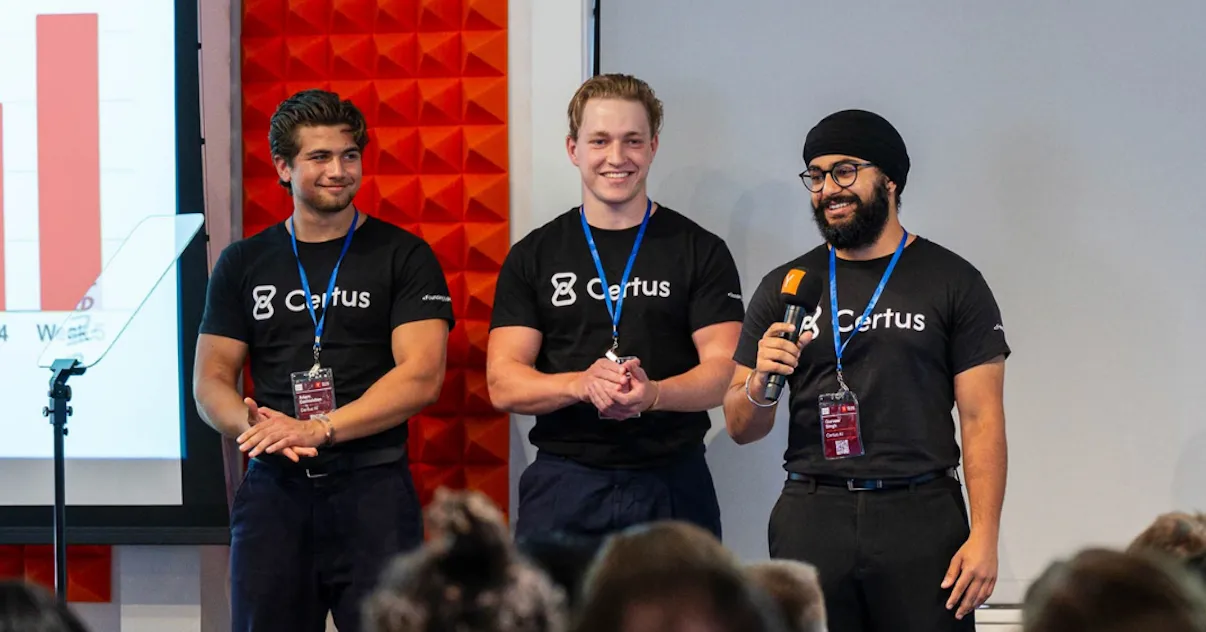
That’s how the three‑person founding team gelled:
Adam: agency operator, sales, GTM, internet‑native marketer
Gurveer: early restaurant marketing and lead‑gen DNA
Isaac: scrappy, full‑stack product and restaurant tooling
Together, they started working not just on generating restaurant demand, but on the infrastructure that would actually handle that demand when it came in.
Certus AI builds AI phone agents designed to replace the restaurant phone line—24/7.
On the surface, it’s simple:
A customer calls the restaurant
An AI agent picks up instantly, every time
It talks naturally, like a competent staff member
It integrates with the restaurant’s POS to place and manage orders

Under the hood, Certus handles:
Takeout and delivery orders
General questions (hours, menu, dietary needs, etc.)
Complaints and issues
Job applications
Catering and large‑party inquiries
Any inbound call that would normally interrupt an overworked front‑of‑house team
The goal is not to create another IVR tree with “Press 1 for X.” The goal is to build something that feels like a reliable, slightly overqualified employee who never gets tired, never misses a call, and never mis‑keys an order.
The Problem
If you’ve called a restaurant at peak time, you already know the problem Certus is solving.
Most restaurants:
Miss calls because they’re understaffed or in the weeds
Answer the phone with someone who sounds rushed or annoyed
Make mistakes taking down orders, leading to refunds, comped meals, and unhappy customers
The phone line becomes a liability:
Lost revenue from missed calls
Damaged brand from poor phone interactions
Operational drag when staff are constantly being pulled away to answer
For independent operators, the math rarely works out to hire a dedicated phone person, especially when margins are already thin and labor costs are climbing.
The Solution
Certus turns the phone line into infrastructure instead of chaos.
Because the AI agent is fully integrated with the restaurant’s POS, it can:
Take and modify orders with full menu awareness
Answer questions based on live information
Process high volumes of calls during peak hours
Handle multiple calls at once without putting anyone on hold
Instead of relying on the most overwhelmed person in the building to catch every inbound call, restaurants offload that entire surface area to software that scales with demand.
The key distinction: Certus isn’t trying to generate new demand. It’s focused on capturing the demand that’s already there and currently being dropped.
Certus is focused on independent restaurants and small franchise groups (roughly under 20 locations). Think of:
The pizza spot you hit every Friday that’s always busy
The local family restaurant where the owner is both GM and host
Small chains that feel the phone pain across all locations
These operators share a few characteristics:
Understaffed, especially on phones
High volume during certain windows
Reliant on repeat customers and word‑of‑mouth
Very aware they’re missing calls, but unable to fully fix it with headcount
Certus drops into the existing tech stack by:
Integrating with the POS as the system of record for orders
Becoming the default for inbound calls (the “front door” for phone traffic)
Handling routine demand while staff focus on in‑person service
Over time, if Certus does its job well, the “phone problem” disappears from the operator’s mental load. It becomes a quiet, dependable revenue channel instead of a constant, low‑grade fire.
Selling into restaurants doesn’t look like selling developer tools or enterprise SaaS. Restaurant owners are:
Time‑poor
Skeptical of yet another software vendor
Very sensitive to ROI and operational risk
Certus’ GTM reflects that reality.

Paid Ads
Adam’s marketing agency background is a direct asset here.
They run targeted paid campaigns (especially on Meta) that speak in the operator’s language:
“How many calls did you miss last Friday? What if you never had to answer the phone again?”
They’re not trying to educate the market on some abstract AI concept. They are pressing on a pain every operator already knows and quantifies mentally each weekend.
The unexpectedly strong GTM motion has been resellers, especially consultants and agencies that implement POS systems like Toast.
These partners:
Already have trust with a portfolio of restaurant clients
Are responsible for “making tech work” in the restaurant
Are always looking for ways to add more value to their clients and earn more per account
Certus offers:
A straightforward integration story (“this plugs into your existing POS”)
Lifetime monthly commissions on accounts they bring in, similar to GoHighLevel’s affiliate structure
Without heavy outreach, this channel has already produced some of Certus’ largest customers. It’s an example of smart distribution: go where trust and access already exist.
Coming from the online entrepreneur world, Adam was initially wary of venture capital and accelerators. The default script in that ecosystem is “…bootstrapping, control, and no one tells you what to do.” Even so, they applied to accelerators—including YC.
They applied to YC twice:
First time: Winter ’25 – rejected
Second time: same core idea, more traction – accepted into YC S25
What changed wasn’t the story—it was the proof.
They showed that:
Restaurants would adopt an AI phone agent
Integrations and operations were executable by a small, scrappy team
There was meaningful early revenue and usage
Internally, the calculus shifted from “we don’t want VCs” to “bootstrapping this will cap our speed—and someone else will raise and outpace us.”
Given the pace of AI infrastructure and the low defensibility of being “just another phone agent” without scale, they chose speed.
Certus is still early, but the next 12 months are not vague.

The plan:
Capital: Use YC as a springboard to raise and deploy capital into product reliability and GTM
Revenue: Drive toward meaningful, multi‑million ARR with strong month‑over‑month growth
Geography: Expand beyond the U.S. into:
Canada – higher minimum wages, tight labor markets, strong restaurant density
UK – more stringent labor laws, higher labor costs, and similar “phone pain”
Product: Avoid new “side products” and focus instead on:
Incrementally improving call quality and accuracy
Reducing edge‑case failures
Making Certus boringly reliable
If there’s a single internal bar they’re optimizing toward, it’s this: Every consecutive call should be something the restaurant can trust—100% of the time.
Spending time with Adam, a few things become obvious quickly:

He’s not a traditional SF founder—and that’s the point. Adam is a South African high school dropout who:
Forged a UK job contract to justify leaving school
Ran a restaurant‑focused agency through serious family financial instability
He didn’t come up through FAANG or elite universities. He came up through YouTube, Discord, and selling directly to restaurant owners.
He’s been inside the restaurant funnel for years. Before Certus, Adam and his co‑founders weren’t theorizing about restaurants—they were running lead‑gen for them.
They saw:
Campaigns that worked
Leads that came in
Revenue that didn’t materialize because no one picked up the phone or followed up
Certus is a direct response to that problem. It’s not a random AI idea bolted onto a random vertical. It’s a wedge born from painful, repeat experience.
He blends internet‑native marketing with “boring” infrastructure. Most founders who can market like Adam gravitate toward consumer brands or flashy software.
Adam chose restaurant phone lines.
He’s taking a very unsexy piece of infrastructure and applying:
Tight positioning
Direct‑response style GTM
Content instincts honed by years of watching the best online operators
That combination: deep, unglamorous problem + sharp marketing…is rare.
He’s founder‑market fit for restaurants, not just for AI. Selling into restaurants is hard. It requires:
Patience
Repetition
Understanding the operator’s day, not just their P&L
Adam has lived that in the agency world, then doubled down by building tooling specific to that segment. There’s no “we’ll do restaurants for a while, then pivot to enterprise” subtext. This is his lane.
He Isn’t Trying to Replace Restaurants; He’s Making Their Existing Demand Actually Count
Adam isn’t trying to change how people discover restaurants or eat. He’s not trying to invent a new ordering behavior.
He’s doing something more targeted and practical:
Focusing on the response layer—what happens when people already want to order, call, or book, and the restaurant’s current systems drop the ball.
Certus is designed to be a critical but invisible part of the stack. If it works, operators don’t talk about it much—they just stop losing money to missed calls and bad phone interactions.
YouTube (“Certus Founding Files”): www.youtube.com/@CertusAIFoundingFiles
Founders Files Instagram: instagram.com/founding.files
Adam’s LinkedIn: linkedin.com/in/adam-gamieldien-067605247
Gurveer’s LinkedIn: linkedin.com/in/gurveer-singh-35168031b
Isaac’s LinkedIn: linkedin.com/in/isaac-nichols-cpt
After dropping out of high school in South Africa, building a restaurant‑focused marketing agency, and watching clients lose money because no one picked up the phone, YC S25 founder Adam Gamieldien is now building Certus AI: an AI phone agent that replaces the restaurant phone line 24/7 and plugs directly into the POS.
With early traction, a strong reseller channel through POS consultants, and a product squarely aimed at capturing already‑existing demand, Certus is quietly turning one of the most neglected parts of the restaurant stack—the phone—into scalable infrastructure.