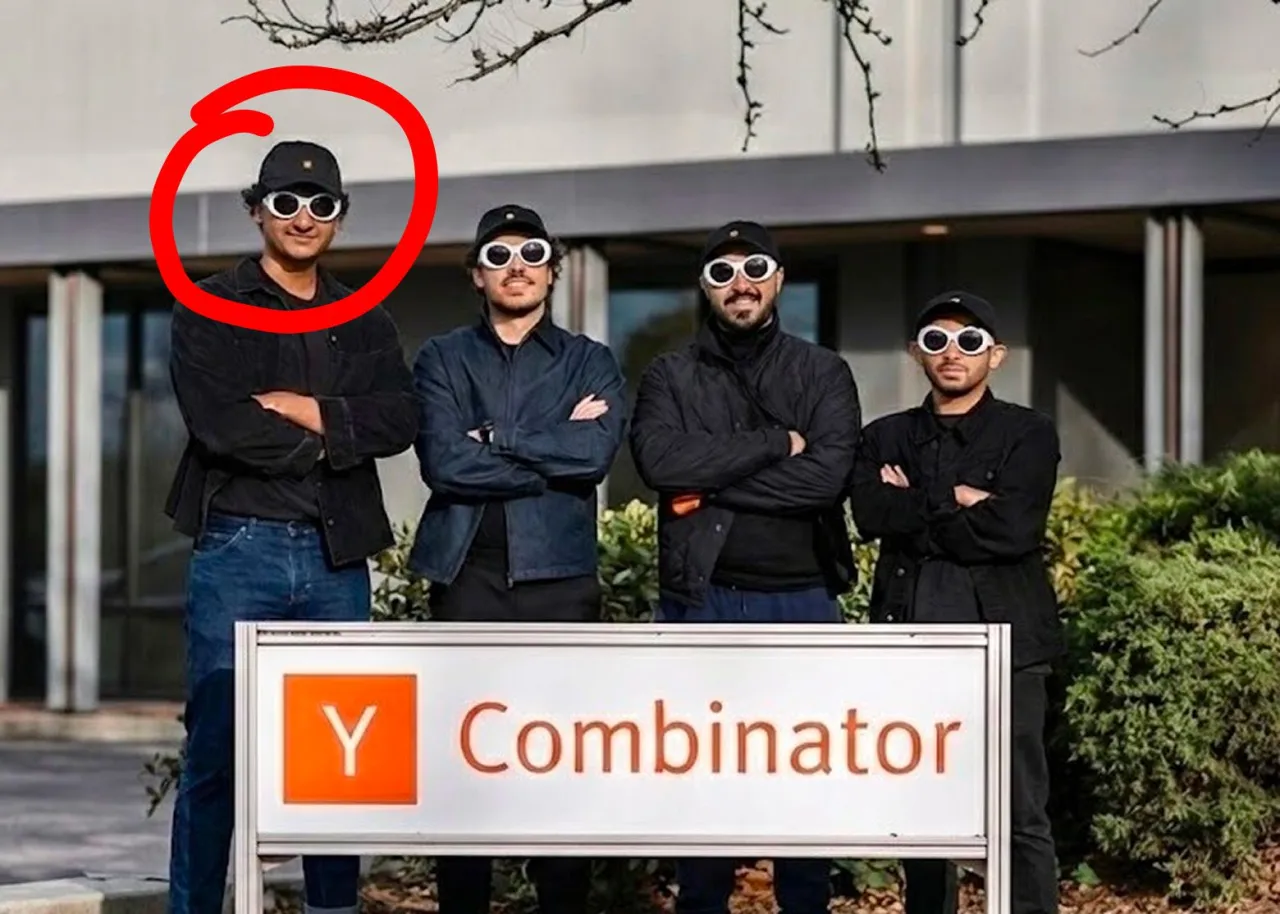
Kamran Majid
Constellation
FOUNDER: KAMRAN MAJRID
Kamran was born in northern Virginia (Loudoun County) and, like a lot of great deep‑tech founders, his interests evolved in clear “phases” that now look surprisingly coherent in retrospect.
As a kid, he was obsessed with animals and certain he’d become a zoologist. Over time that fascination shifted from animals themselves to the idea of exploration and discovery: research, novel ideas, pushing into the unknown.
By middle school and high school, that curiosity found a new outlet: robotics.
His school had a strong robotics program, so he jumped in. The early years weren’t glamorous—lots of stumbling and not a lot of trophies—but he didn’t quit. Five years later, his teams were performing at a high level, and robotics had quietly rewired how he thought about complex systems, tradeoffs, and building under constraints.
A pivotal influence came from a high‑school physics teacher who pushed him toward a NASA program for high‑school students. If you did well enough in a series of papers and projects, you got invited on‑site for a week‑long mission design sprint with real NASA engineers.
Kamran got in.
He did the program, then was invited back as an intern. That experience kicked off his “space arc” and reframed his ambitions: not just doing cool engineering, but working on missions and infrastructure that matter at planetary scale.
The question then became: what should he actually study to be a “space engineer” at the frontier?
He chose the University of Illinois Urbana‑Champaign and did something that would define his intellectual profile: he double‑majored in Computer Science and Philosophy.
Computer Science, because even with years of robotics under his belt, he knew his weakest area was programming. Philosophy, because he didn’t want to give up long‑form thinking, argument, and ideas.
The result was a split life he loved:
Half his time building software and sharpening his technical toolkit. Half his time in metaphysics and other philosophy seminars, where ideas were the currency.
He was the kind of student who stayed after class for hours, camping out in professors’ offices until they kicked him out so someone else could have office hours.
That immersion in ideas—the sense that you could build careers and lives around them—made academia deeply appealing. For a while.
SPACE X AND THE REALITY OF “FAST”
After Illinois, Kamran went where many of the best space engineers go: SpaceX.
He started on Starlink in Redmond, Washington, then moved to Starship in LA, then back to Washington. From the outside, SpaceX is pure velocity and ownership. From the inside, Kamran saw both the magic and the mess.

starlink being deployed from a falcon 9 rocket
He landed on a tiny team (three people, and he was the only software engineer) working on what amounted to the brain of Starlink’s ground and space network: synthesizing data across guidance/navigation/control (GNC), operations, hardware, ground sites, and more to help decide where to place infrastructure and how to keep users online.
It was high‑pressure, mission‑critical work.
Elon himself accidentally added fuel to the fire. In a now‑legendary all‑hands story, Elon was reportedly on a private jet playing Dota on New Year’s and called Starlink leadership because the game was lagging. The directive that came out of that moment was simple and brutal: drive median (P50) latency under 20ms by January 1, 2025.
Suddenly, a vague goal turned into a hard deadline—and the entire organization went into latency‑reduction mode.
Kamran’s team sat in the middle of it all:
Pulling telemetry on satellites, ground stations, and data centers
Understanding traffic congestion and link health
Finding where the network was brittle, where outages started, and how to design redundancy
Over roughly a year, their software saved Starlink millions of dollars by:
Predicting failure modes
Recommending infrastructure deployments
Helping avoid catastrophic outages in places like Ukraine, where Starlink connectivity has become a literal life‑or‑death dependency
Those years cemented two truths:
Mega‑constellations are here—and only getting bigger
The software “brain” coordinating those constellations is now existentially important
THE PHD INTERLUDE - AND ITS LIMITS
After SpaceX, Kamran tried to return to the world of ideas, starting a PhD in theoretical physics at the University of Washington.
On paper, it was perfect: deep thinking, hard problems, and a direct tie to space.
In practice, the pace mismatch was brutal.
He went from sleeping four hours on launch weeks, being on console at 3 a.m., and pushing code that directly affected thousands of users… to reading and annotating a couple of papers a day.
For many people, that’s a dream. For Kamran, in his early 20s, it felt misaligned with the urgency he felt about the problems he wanted to work on.
He started reflecting on his time at SpaceX, the scale of technical debt he’d seen in satellite networks, and the coming wave of constellations.
The conclusion: the frontier was no longer inside big institutions. It was in whatever he could build himself.
COMPANY: CONSTELLATION
Constellation is building an operating system for space networks—a predictive intelligence layer that keeps mega‑constellations and satellite networks resilient in real time.
The core insight comes from Kamran’s time at SpaceX:
Starlink, the most advanced mega‑constellation to date, has thousands of satellites in orbit—and yet, even there, the software coordinating the network is full of technical debt.
Starlink recorded over 4,000 outages in 2025 alone. Each ranged from a few thousand dollars in impact to tens of millions. One outage wiped out connectivity across all of Latin America.
Now zoom out.
By 2030, operators around the world are expected to deploy over 70,000 satellites in low‑Earth orbit. Most of those operators don’t have Starlink’s resources—or tolerance for failure.
And yet they’re building networks that:
Span satellites, ground stations, data centers, and fiber
Rely on fragile links through atmosphere and space weather
Are being used for everything from consumer broadband to Earth observation to defense
The world is rapidly filling orbit with complex space infrastructure—but there is no standard “brain” coordinating it, predicting failures, and routing around them.
Constellation is building that brain.
HOW CONSTELLATION WORKS
Constellation sits on top of a satellite operator’s existing infrastructure and telemetry.
It ingests and learns from:
Signal‑to‑noise ratio (SNR) and link health
Traffic, congestion, and capacity patterns
Weather (atmospheric conditions) and space weather
Satellite positioning and ground station availability
From there, it uses reinforcement learning and other advanced ML to make per‑node, per‑timestep predictions about the network.
In practice, that looks like:
Five minutes before a link degrades or fails, the operator gets a notification:
“This link has X% chance of degrading. Here’s a recommended reroute. Press ‘check’ to execute.”
Constellation isn’t just describing the network—it’s recommending actions that maintain uptime and resilience.
That matters at every scale:
For Starlink‑scale constellations, where each outage is expensive and geopolitically sensitive
For new networks that can’t afford repeated failures
For operators in defense, commercial connectivity, and high‑value sensing missions
Kamran’s ambition is straightforward to state and non‑trivial to execute:
Make Constellation the standard operating system for anyone serious about running space networks.
CO-FOUNDERS: FROM CAPITAL ONE TO CONSTELLATION
Kamran didn’t build Constellation alone.
He met his co‑founders three years ago during an internship at Capital One, on what was ostensibly a very “normal” big‑company engineering team.
It didn’t stay normal for long.
He and two of them—Laith and Raaid—were on the same team, finishing their work early and resorting to LeetCode on the whiteboard out of boredom. Another, Omeed, was in the same intern class on a different team.
What stood out to Kamran wasn’t just that they were competent. It was that they were operating on a different level—exceptional engineers who later went on to grad school in AI.
So when the idea for Constellation crystallized, he knew exactly who to call.
He laid out the problem, the opportunity, and the role their AI expertise could play.
They were in.
On that same first call, Kamran also said something else: he was going to apply to a16z and YC, and they were going to get into one of them.
Omeed added his own twist: if they got into YC, he’d tattoo Kamran’s name on his finger.
They did get into YC (W26), with Kamran paired with YC partner Jared Friedman—who also backs Astranis and other major space names.
The tattoo question is still open.
ICP
Constellation’s customers are satellite and space‑network operators across both commercial and defense.
On the commercial side, that ranges from:
Small operators with a handful of satellites
Up to large providers like Astranis, SpaceX, and others
It also includes ground segment companies and infrastructure providers—think phased‑array ground station players like Northwood Space and other emerging names.
On the government and defense side, they’re initiating conversations with defense primes and agencies like NASA that manage and deploy large constellations and space‑based assets.
The throughline: anyone operating a constellation or space network where uptime and resilience are critical.
Why It’s a No‑Brainer for Smaller Players
One of Constellation’s biggest advantages is something the big operators can’t easily replicate.
Because Constellation isn’t launching satellites itself, it can use federated learning across multiple constellations—learning generalized patterns about failures, congestion, and environmental effects without leaking any one customer’s data to another.
That means a company with a single Earth‑observation satellite, which today might find 70% of its imagery unusable because of atmospheric interference, can access Starlink‑grade insights on when and where to capture useful data.
You don’t need to be a mega‑constellation to benefit. You just need to be in space.
GTM
Constellation’s go‑to‑market starts with deep design partnerships.
They’re working closely with a small set of defense and commercial operators to co‑design the product, integrate it into real networks, and validate its value in production.
Those design partnerships convert into:
Paid pilots at ~$50K/year for early partners
From there, full integration comes in at roughly $500K annually per customer
In exchange, operators get:
Predictive outage detection and rerouting
Reduced downtime (and associated revenue and mission loss)
A way to harden their networks without having to build an internal AI “resilience team”
They enforce strict data‑segregation policies so that no operator’s proprietary data is exposed to another, even as the underlying models benefit from broader patterns learned across the ecosystem.
Over time, the goal is clear: become the default operating system layer every serious space‑network operator plugs into.
THE YC EFFECT & THE NEXT 12 MONTHS
Constellation is still early—but the trajectory is steep.
YC’s impact, especially in a non‑traditional YC vertical like space, shows up clearly:
Obsession with talking to customers early (operators, ground providers, defense primes)
A bias toward shipping and real deployments rather than whitepapers
Hard cadence: tangible milestones and visible progress by Demo Day
Over the next year, Kamran’s picture of success looks like this:
Constellation is integrated as the resilience layer for multiple constellations
Design partners have converted into meaningful recurring revenue
New satellite and space‑network operators treat “plug into Constellation” as a default step in deployment
In other words: if you’re putting a network in space, you don’t just buy satellites and ground stations. You also install the operating system that keeps it alive.
WHY KAMRAN STANDS OUT
He’s a systems engineer to the core. Most founders in space either lean pure research or pure business. Kamran’s native language is systems.
At SpaceX, he was responsible for:
Reconciling satellite, ground, and operations constraints
Turning messy telemetry into actionable deployment and routing decisions
Building tools that literally kept people connected in war zones
That mindset—sitting at the center of competing constraints and forcing convergence—is exactly what early‑stage company building requires.
He’s operated at the frontier of space at scale. Kamran didn’t just “work in space.” He worked on Starlink and Starship, saw the messy reality of mega‑constellations, and understood both the brilliance and the brittleness of the systems we’re putting in orbit.
He’s seen how:
Rushed deployments create technical debt
Outages cascade across real‑world users and geopolitical theaters
Better software could have prevented real, costly failures
That experience makes Constellation feel less like a slide‑deck idea and more like an overdue piece of infrastructure.
He’s building an OS, not another satellite. In a space ecosystem crowded with new launchers, sensors, and spacecraft, Kamran is focused on a different layer: intelligence.
He’s not trying to compete on hardware. He’s building the software brain that orchestrates:
Satellites
Ground stations
Fiber and data centers
Dynamic, adversarial environments like space weather and conflict zones
It’s an “OS for space networks” play at exactly the moment when the number and importance of those networks is exploding.
He’s using federated learning to give small players superpowers. Most operators will never have Starlink‑scale data or AI teams.
Constellation’s federated learning approach means:
A small constellation can benefit from patterns learned across thousands of satellites and years of telemetry—without anyone losing control of their own data
That’s a fundamentally different value proposition than “…hire a few ML engineers and try to do this yourself.”
He’s importing YC discipline into a frontier‑tech niche. Like defense, space isn’t a typical YC vertical. Sales cycles are long. Hardware and regulation loom large.
Kamran is threading the needle:
Talking directly to operators and primes
Shipping real software and integrations early
Treating outages and resilience like a measurable, improvable KPI
He’s applying YC’s “launch, learn, iterate” playbook to infrastructure that usually moves at glacial speed.
He Isn’t Launching More Satellites; He’s Making Space Networks Resilient
Kamran isn’t trying to flood orbit with more hardware or claim that software alone will fix everything.
He’s doing something narrower and more leveraged:
Making sure the constellations we already have—and the tens of thousands coming—stay online, resilient, and intelligent.
Constellation is the operating layer that lets the new space economy scale without collapsing under its own complexity.
TL;DR
After years as a systems engineer at SpaceX, where he helped keep Starlink’s massive constellation online, YC founder Kamran Majid is now building Constellation, an AI operating system for space networks.
Constellation sits on top of satellite and ground infrastructure, uses reinforcement learning and federated insights to predict failures, and recommends reroutes before outages happen—turning fragile constellations into resilient, intelligent networks.
Backed by YC and working with both commercial and defense operators, Kamran’s goal is simple: if you’re putting a network in space in the next decade, you’ll run it on Constellation.
FoundersBrief. New York.
Archive